Newspaper Al-Ahram
Publication date May 7, 1968
Language Arabic
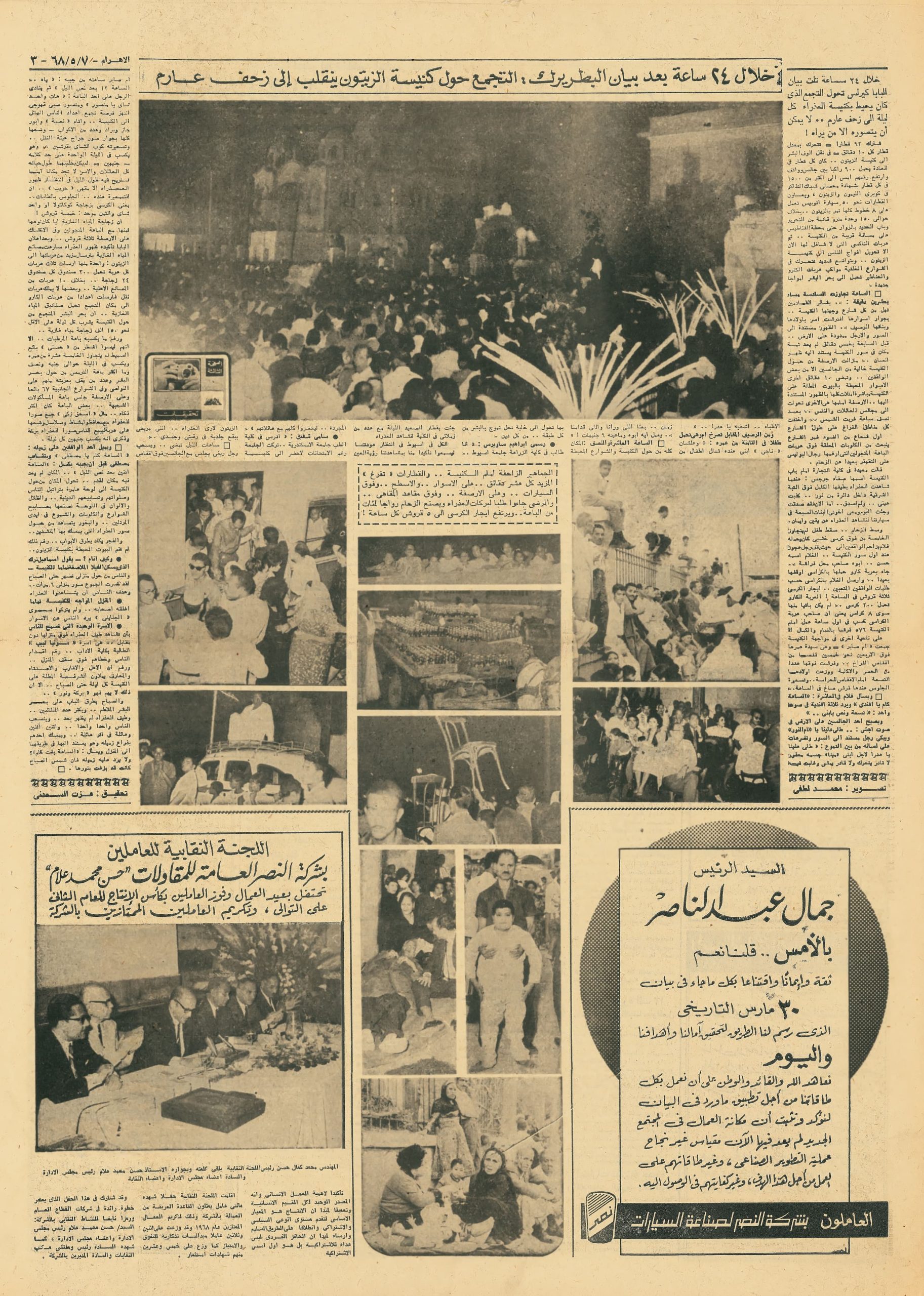
Within 24 Hours After the Patriarch’s Statement: The Gathering at Zeitoun Church Turns into a Human Tide
Within just 24 hours after Pope Cyril VI’s statement confirming the apparition of the Virgin Mary, the nightly gathering around Our Lady of Zeitoun Church transformed into an overwhelming human flood, something one could hardly imagine without witnessing it! Unprecedented Crowds Flood Zeitoun
A total of 92 trains, departing every 10 minutes, transported throngs of people to Zeitoun.
Each train, which normally carried about 900 passengers, was crammed with over 1,500 travelers, according to ticket collectors at Kobri El-Limoun and Zeitoun stations.
Around 50 buses running on eight routes converged on Zeitoun, along with about 150 metro cars shuttling visitors from Tahrir and Bab El-Hadid to El-Fanatis station, just a short walk from the church. Then came the taxis, which now had no other occupation but ferrying wave after wave of people to the Church of Zeitoun.
And, moving humbly through the backstreets, convoys of horse carts and carriages made their way toward the vast human sea, carrying yet more waves to join the multitude.
By 6:20 p.m., signs of the incoming multitudes began appearing from every street leading toward the church. Families spread blankets along the sidewalks; mothers, daughters, and children sat shoulder-to-shoulder against the church fence.
By 6:55 p.m., not an inch of space remained along the fence for anyone to lean on. Ten minutes later, every surrounding wall and house fence overlooking the church had been occupied by spectators, sitting and waiting, while entire families claimed sections of the pavement.
The glow of the first electric bulbs from vendors’ stalls filled the air, pushing back the dusk as street police forced hawkers to retreat from the church’s immediate perimeter.
In front of the church gate, Safaa Gerges, a teaching assistant at the Faculty of Commerce, said: “When I first saw the Virgin, her full figure within a circle of light above the eastern dome, I doubted my own eyes and couldn’t believe it. But now, I believe. Today I came back with my seven sisters in our car to see her again, with conviction and faith.”
In the dense crowd, a five-year-old boy fell from a wooden chair carried by a young vendor named Hassan, whose father, a furniture renter, had brought a cart filled with 200 chairs. The rate: three piasters per hour. Only eight chairs remained by the first hour, meaning the father had already earned 576 piasters (nearly six pounds) in just one hour!
Nearby, “Om Saber”, a woman in her forties, had stacked 50 chicken crates as makeshift benches covered with mats and rugs. Her nine children guarded them, charging one piaster per hour for each seat.
At 9:30 p.m., a ten-year-old asked, “What time is it, sir?”
Three men answered in unison: “Half past nine, son.”
Moments later, a hoarse voice cried out:
“Look upon us, O Mother of Light!”
A man leaning against the wall wept, praying: “Look upon us, O Virgin, for the sake of my son Mina. His body is paralyzed, he can’t move or walk. The doctors have failed… heal him, O Virgin.”
Across the street, another mother held her eight-year-old child and cried: “For my son Nagi, he’s had polio for years. We sold everything behind and before us… what can his father do on a salary of nine pounds a month?”
By 10:30 p.m., every street surrounding the church had become a humming beehive of humanity, men and women of every class, every faith.
Rasmy Ibrahim Sawiris, a student from Assiut University, said:
“I came by the Upper Egypt night train with my classmates to see the Virgin. Everyone back home is waiting for our testimony, so that next time, they’ll all come with their families.”
Sami Shafiq, a medical student from Alexandria University, added: “I left my studies despite exams, I had to come see the Virgin. I have skin spots on my neck and body…”
As the night hours passed, a rural man sitting among those perched on Umm Saber’s crates pulled his watch from his pocket, it was midnight. Then he called out to one of the vendors:
“Bring me a cup of tea, Mansour.”
Mansour, a young tea boy, had seized the opportunity of the massive crowds gathering at the church. He had set up a small stand with a kerosene stove, teapot, and a few cups beside the Public Transport Garage wall. His rate: two piasters per cup—earning him two pounds a night, a sum he said he’d never dreamed of making in his life.
Families, unable to find shelter, sat outdoors till dawn, waiting for the Virgin’s light.
Only “Hareeb Café” offered chairs, but seating required an order, five piasters per tea or soda. Soft-drink vendors made brisk business too.
Following the Patriarch’s declaration, soda factories rushed trucks to Zeitoun. One factory alone sent three trucks, each loaded with 300 crates (24 bottles each). Altogether, about 150,000 bottles of soda were sold nightly to the crowds.
Despite the profits made by the soft-drink vendors, none were “shrewder than Hosni,” a fifteen-year-old bagel seller who earned about one and a half pounds a night.
All around the sea of people stood 67 lupin vendors, their carts stationed at street corners and along side roads. On the sidewalks, sellers of popular street foods sat with their trays — among them, Isaac Zaki, who proved to be the most resourceful. He had arranged souvenir photographs of the Virgin, along with combs and chains, on his cart, selling them as blessed keepsakes. He told reporters with pride that he earned two pounds every night.
Someone leaned on his friend and asked sleepily, “What time is it now, Mostafa?”
Mostafa yawned before answering, “It’s two after midnight.”
There was no longer room for a single step, the entire area surrounding the church had transformed into a living painting filled with the hymns, prayers, and praises of the people. The street lamps, bulbs, and candle flames in the hands of the chanters painted shadows and colors across the scene, while incense rose around the images of Our Lady carried aloft by the singers.
Though dawn was nearing, the streets encircling the Church of Zeitoun showed no sign of sleep.
“How could I sleep?” said Ismail Tark, who lived in the villa directly beside the church.
“People keep vigil around my house until morning. The crowds have broken my fence six times, all for one purpose: to catch a glimpse of the Virgin.”
The house directly opposite the church was closed by its owners, leaving only their gardener to fend off the crowds.
The only family that allowed the public to view the apparition of Our Lady from their rooftop, free of charge, was the family of Sonia Labib, a student at the Faculty of Arts. Despite the constant trampling of their roof tiles by the eager crowds, they made no complaint.
“It’s all a blessing and light,” Sonia said simply. Every night until morning, relatives and friends filled the balconies overlooking the church. Yet no one minded — it was, to them, grace and blessing.
As morning knocked upon the sea of humanity, yawns spread among the weary watchers. The Virgin’s apparition had not appeared that night, and the crowd slowly began to disperse, one by one, two by two, family after family.
One man leaned on his companion’s arm as they walked home and asked drowsily, “What time is it now?” His friend did not answer, for the sun had already risen over Zeitoun.
Report by Ezzat El-Saadani